Most security personnel operate at a number of different sites, at various times (e.g., overnight), and independently from their supervisor, which means most of the time, these individuals are working by themselves for extended lengths of time without being able to have face-to-face contact with their supervisors.
Therefore, it is essential that operational managers have a method for determining whether employees are safe, active, and responding as they should.
If there is no indication an employee has completed their scheduled check-in, then the longer the follow-up takes to complete, the less likely it will be possible for operational managers to determine what is taking place on the premises.
Workforce management software such as Guardhouse provides a structured way for security companies to monitor employees' activities and respond more promptly if problems occur.
Lack of Visibility Over Lone Worker Activities
There are several types of security officers who work independently for large parts of their daily/nightly shifts.
Mobile patrol teams, gatehouse officers, and remote site employees travel between assignments frequently and rarely communicate directly with their supervisors.
A lack of structure in monitoring employees' activities leads to security organizations typically relying upon a variety of manual means to verify an employee's status.
Examples include making telephone calls, utilizing radios, or manually contacting each other.
While these approaches may be sufficient for small teams, they generally are impractical to implement as the size of the team increases.
For example, larger security organizations managing multiple sites and/or shifts find it increasingly difficult to ensure that all employees' activities are monitored on a regular basis both during the daytime and nighttime hours.
In addition, even though check-ins are usually missed during periods of high volume or during nighttime operations, this does not necessarily mean the missed check-in was overlooked.
The result is reduced visibility over individual sites and delayed coordination of responses.
The Difficulty of Implementing Automated Escalation Processes
Manually escalating a problem relies upon supervisors observing that an employee has not responded as required in a timely manner.
At the same time, supervisors also handle numerous responsibilities including:
- Dispatch activity
- Incident reports
- Scheduling changes
- Client communications etc.
During busy shifts, it may become increasingly difficult for supervisors to reliably perform welfare checks.
The absence of automation results in:
- Missed check-ins may be undetected
- Process variability among teams
- More difficult to track patrol activity
- Later evaluation of response history becomes more difficult
In general, this situation affects overall site awareness and coordination of responses in all aspects of security company operations. A more reliable method of monitoring employees and implementing escalated processes over multiple sites and departments is necessary for growing security companies.
Utilizing Welfare Monitoring Workflows
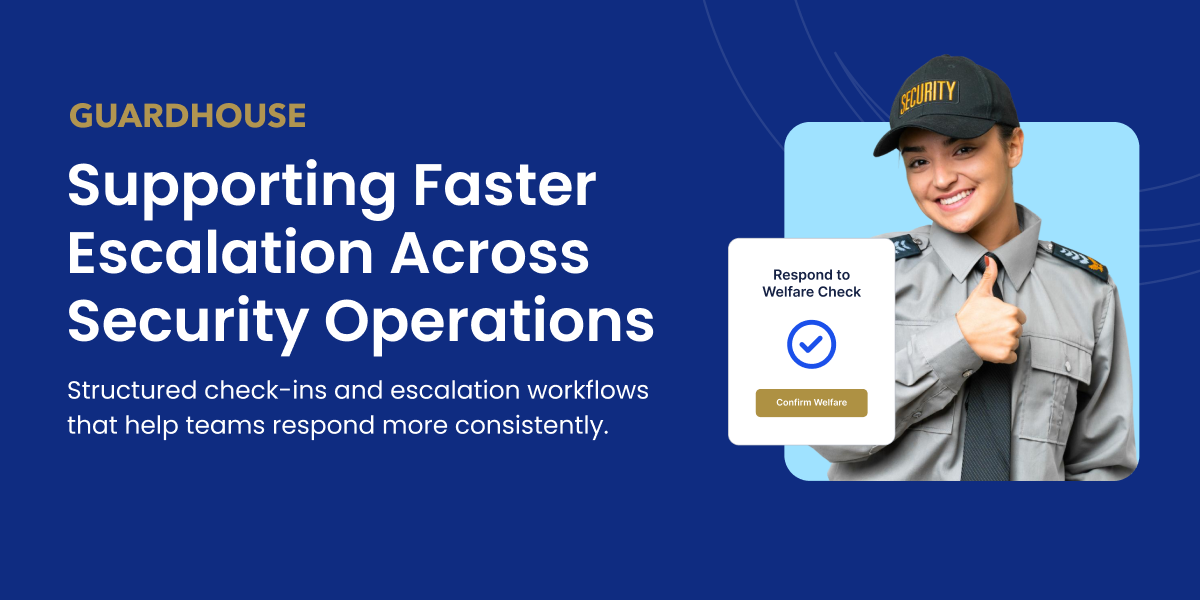
Welfare checking workflows provide security organizations with a method to monitor lone workers and mobile teams with greater consistency than ever before.
Inside Guardhouse workforce management systems, supervisors can establish routine welfare checks during a shift for each employee.
If an employee fails to meet their scheduled response obligation, the system notifies supervisors and sends automatic escalation alerts.
This allows teams to respond more rapidly and minimizes the necessity for manual follow-up.
Instead of utilizing separate applications or unconnected communication methods, operational groups can manage monitoring, escalation, and reporting inside one single system.
Key characteristics of Guardhouse welfare monitoring workflows include:
- Scheduled welfare checks for employees
- Automatic escalation alerts based upon failure to respond
- Notifications to supervisors
- Customizable response intervals
- Historical record tracking of escalation responses
- Reporting centralized into a single location
Tracking via NFC Checkpoints
NFC-based checks enable the supervising team to see the patrol activities more clearly.
Officer’s during patrols will be able to use their device to "tap" the NFC checkpoints that have been placed throughout a facility/site. The officer's location at which they performed patrol activities along with the date/time that the checkpoint was completed will be documented.
If an officer fails to respond to subsequent contact/misses their next check-in, the supervisor can view the officer’s most recent documented location (checkpoint) to obtain insight into the officer’s patrol activities.
Operations teams will have greater visibility of all aspects of large sites as well as mobile patrol routes with the use of structured reporting rather than having to rely solely on phone calls and/or manually updating systems.
You may find out more regarding NFC-based welfare checks from the following link:
Reporting Helps Teams Review Escalation Activity
Structured reporting allows security companies to review how escalation processes are functioning across both teams and sites.
Welfare check reporting provides the ability for supervisors to monitor:
- Missed check-in patterns
- Timing of escalations
- Nighttime activity
- Completion of patrol by the officer
- Follow up by supervisor of officer
- Issues related to site specific monitoring
With all this data available in one area, it becomes much simpler for operations teams to evaluate existing workflows and develop improvements to response times going forward.
Additionally, this enables security companies to document and keep clear records of their workforce activities on a daily basis.
Read the link below for further information on Guardhouse welfare check status reports.
Guardhouse Welfare Check Status Reports
Better Monitoring Across Security Operations
The structured nature of welfare monitoring, combined with automation of escalation procedures, scheduled check-ins using mobile devices, NFC based verification and integrated reporting capabilities through Guardhouse, enables operations teams to have improved awareness of all aspects of daily operations (sites, patrols, etc.) and thus improves coordination for timely responses.
This results in:
- Quicker processing of escalation events
- More precise tracking of patrol activities
- Consistent follow up by supervisor
- More detailed documentation of responses
- Greater awareness of each individual site
- Improved communication between teams
For security companies managing multiple locations and mobile workforces, automated welfare checks provide a more reliable way to support staff monitoring and day-to-day operational awareness.
If you want to learn more about Guardhouse automatic welfare checks, you can contact us:
For AU: https://meetings.hubspot.com/brandon-delves/guardhouse-demo-clone
For UK: https://meetings.hubspot.com/samuel-de-lange/partnerships-meeting
For US: https://meetings.hubspot.com/julian-cartwright/julians-sales-calendar
For Brazil: https://meetings.hubspot.com/thales-batista